



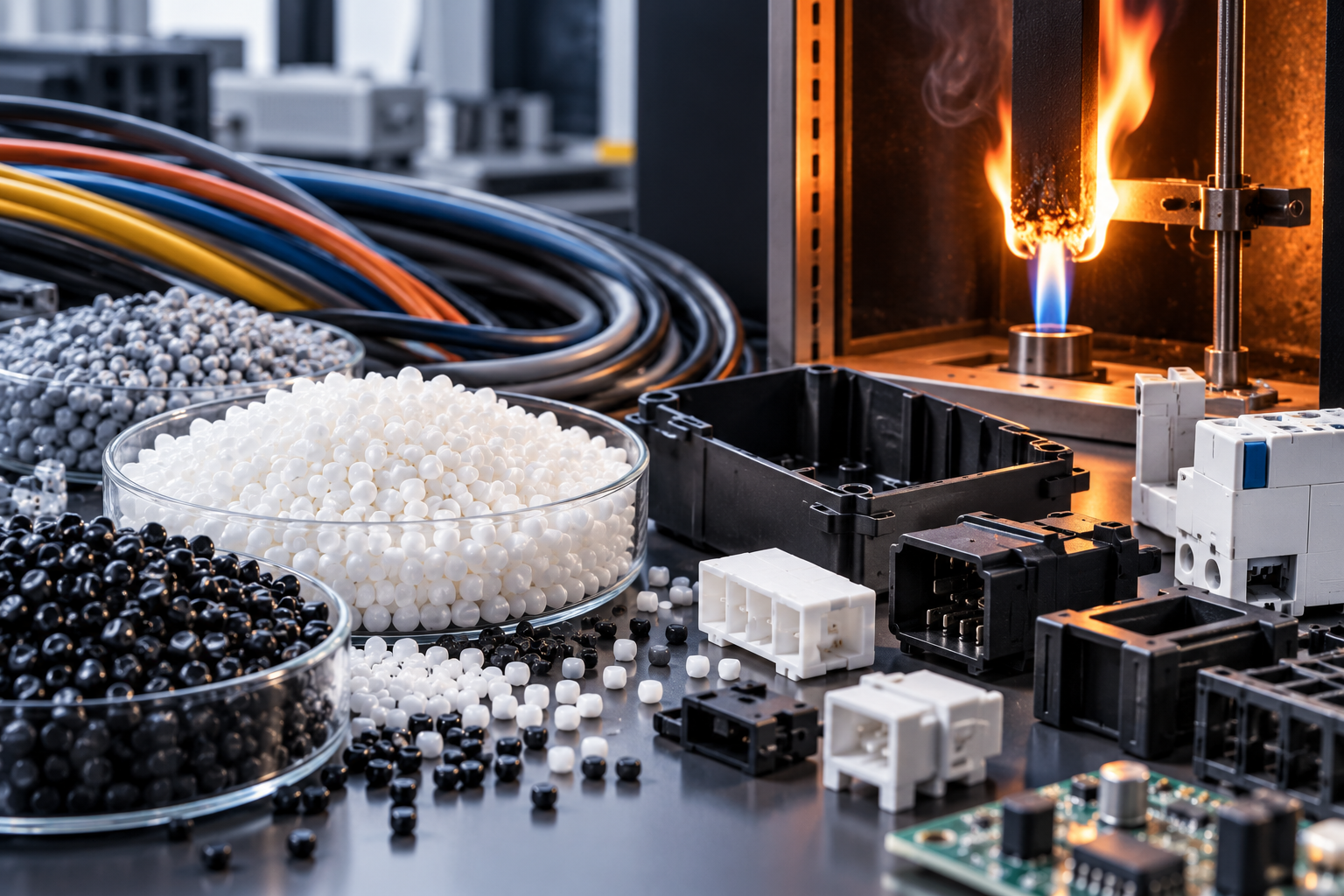
Fire safety is a non-negotiable requirement in electrical and electronics (E&E) plastics. Every enclosure, connector, cable jacket, and circuit board housing must resist ignition and limit flame spread to protect equipment, property, and lives. Flame retardant additives are the key to achieving this protection — and when delivered through masterbatch technology, they offer consistent performance, easier processing, and full regulatory compliance. This article explores how flame retardant masterbatch works in E&E applications, the importance of UL94 V0 ratings, and what manufacturers should consider when selecting additives.
Why Flame Retardant Additives Are Essential for E&E Plastics
Most engineering plastics are inherently flammable because of their carbon-based polymer structure. In E&E applications — where components carry current, generate heat, and sit inside enclosures — fire risk is a fundamental concern. Without proper flame retardant treatment, a single electrical fault could ignite the plastic housing, producing toxic smoke and spreading fire rapidly.
Flame retardant additives interrupt the combustion cycle through physical or chemical mechanisms: they can cool the material via endothermic decomposition, form a protective char layer that limits oxygen access, or quench free radicals in the gas phase. The result is delayed ignition, slower flame spread, reduced heat release, and lower smoke output — all critical for meeting building codes and product safety standards.
For plastic manufacturers and compounders, the simplest and most reliable way to incorporate these additives is through a flame retardant masterbatch — a concentrated blend of flame retardant chemicals dispersed in a polymer carrier resin. Masterbatch ensures uniform distribution, eliminates powder handling issues, and integrates easily into existing production lines.
Understanding UL94 V0 Compliance for Plastic Enclosures
UL 94, published by Underwriters Laboratories, is the most widely referenced flammability standard for plastics in North America. Within this standard, V0 is the most stringent vertical burn rating commonly required for E&E enclosures. A material rated V0 must self-extinguish within 10 seconds after each of two flame applications, with no flaming drips that ignite a cotton indicator placed below.
Achieving V0 requires careful selection of both the base polymer and the flame retardant system. Common resin systems that can reach UL94 V0 include FR-grade PC/ABS blends, FR polycarbonate, FR ABS, FR nylon, and FR PBT/PET. Notably, the V0 rating is thickness-dependent — a material rated V0 at 3.0 mm may fail at 1.5 mm — so testing must be conducted at the exact end-use thickness.
Flame retardant masterbatch makes this reproducible. By delivering a consistent ratio of active additives in every pellet, masterbatch eliminates the variability that can cause sections of a molded part to fall out of compliance.
Halogenated vs. Non-Halogenated Flame Retardant Masterbatch
The flame retardant market is in the middle of a major shift. For decades, halogenated (bromine- and chlorine-based) flame retardants dominated because of their high efficiency and low cost. However, tightening environmental regulations — including REACH restrictions in Europe and new state-level bans in the U.S. — are driving demand toward non-halogenated alternatives.
Non-halogenated flame retardant masterbatch systems fall into three main categories:
- Phosphorus-based: Highly effective in PC/ABS and PPO/HIPS blends. They offer good UV stability and produce very low toxic smoke, making them ideal for visible enclosures and indoor electronics.
- Metal hydroxides (ATH, MDH): Commonly used in polyolefins and cable compounds. They work by endothermic cooling and are inherently non-toxic, though higher loadings are typically required.
- Intumescent systems: Form an insulating foam layer on the surface during combustion, protecting the underlying material. These are gaining traction in thin-wall applications.
For manufacturers targeting the U.S. market, specifying non-halogenated flame retardant masterbatch is increasingly a compliance requirement — not just a sustainability preference.
Key Applications in Electrical and Electronics Components
Consumer Electronics and IT Equipment
Enclosures for televisions, computers, routers, power supplies, and smart home devices must meet UL94 V0 or V1 ratings. Flame retardant masterbatch allows molders to produce these enclosures with consistent fire protection while maintaining surface finish, color accuracy, and impact strength. Mine Colours offers custom-formulated flame retardant masterbatch that can be combined with color masterbatch in a single dosing step — reducing downtime and simplifying inventory.
Cable and Wire Insulation
Cables inside electronic assemblies and building infrastructure are governed by additional standards that address flame spread, smoke density, and toxicity. Non-halogenated flame retardant masterbatch for wire and cable compounds is critical in applications like data center cabling, EV charging cables, and appliance wiring, where low smoke and low toxicity are as important as flame resistance.
Conclusion
Flame retardant masterbatch is an essential tool for E&E plastics manufacturers who need to meet fire safety standards without compromising processing efficiency or part quality. As regulations continue to tighten around halogenated chemistries and PFAS compounds, the industry is moving decisively toward non-halogenated solutions that deliver both compliance and environmental performance.
Looking for a reliable masterbatch manufacturer for your electrical or electronics components? Mine Colours offers custom flame retardant masterbatch, color masterbatch, and plastic additives tailored to your production needs. Contact us to request a sample or discuss your specifications.