



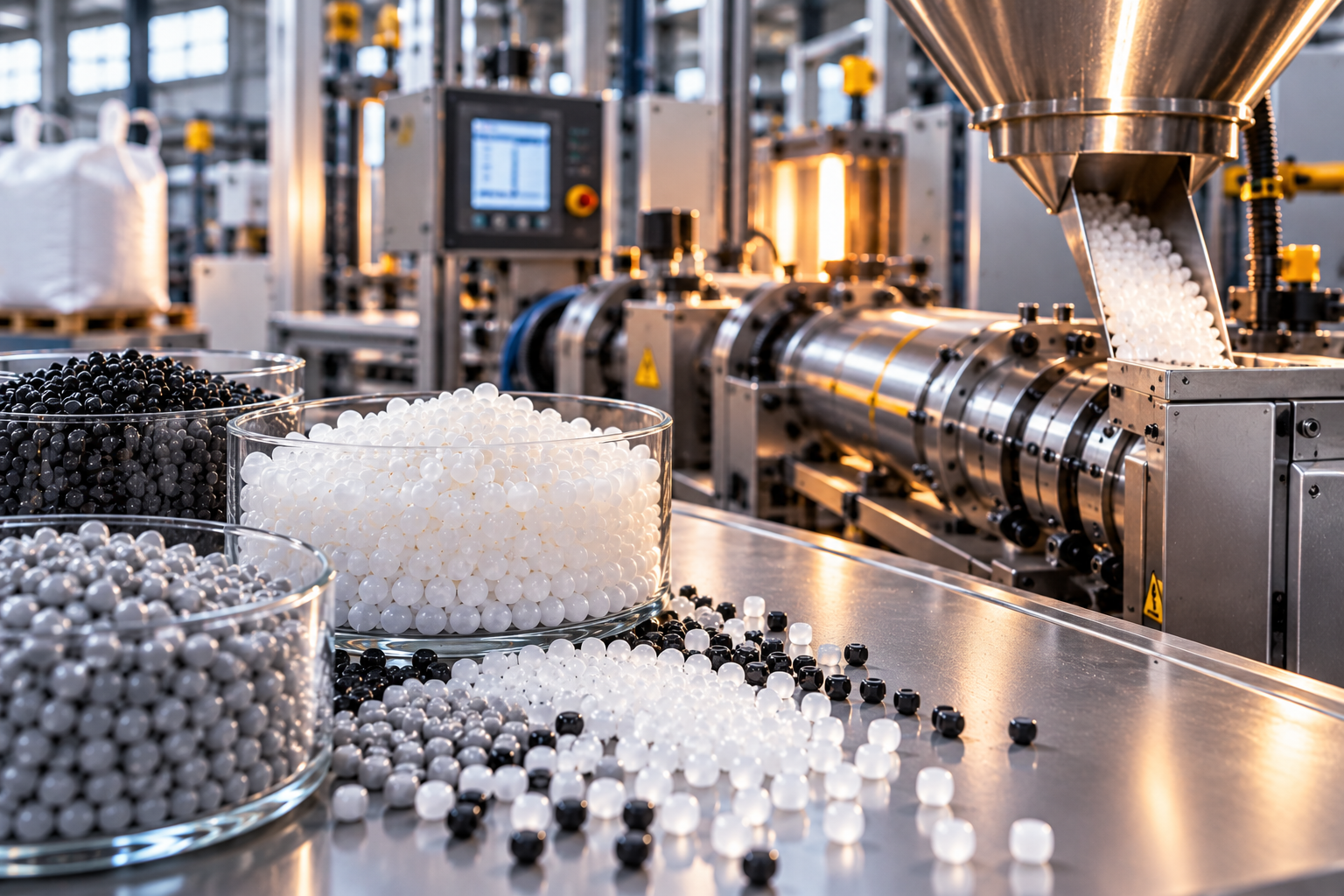
How Antioxidant Masterbatch Prevents Degradation in Plastic Processing
Plastic manufacturers face a persistent challenge: thermal-oxidative degradation during processing and throughout the product’s service life. High temperatures, mechanical shear, and exposure to oxygen can cause polymer chains to break down, leading to discoloration, brittleness, loss of mechanical strength, and ultimately product failure. Antioxidant masterbatch offers a practical, cost-effective solution that protects polymers from the moment they enter the extruder to the end of their useful life.
Understanding Thermal-Oxidative Degradation in Plastics
Degradation begins when weak sites within polymer chains — created during polymerization, previous processing, or storage — encounter sufficient energy to form free radicals. These radicals react rapidly with oxygen to produce peroxy radicals, which then generate hydroperoxides. The hydroperoxides decompose into new reactive species, creating a chain reaction that accelerates polymer breakdown.
Different polymers exhibit different degradation patterns. Polypropylene typically undergoes chain scission, which increases melt flow and reduces molecular weight. Polyethylene may experience both chain scission and crosslinking. Without proper stabilization, repeated processing cycles can dramatically alter melt behavior and compromise finished product quality.
Key Factors That Accelerate Degradation
- High processing temperatures: Extrusion, injection molding, and film blowing expose polymers to elevated temperatures that accelerate radical-forming reactions.
- Mechanical shear: High screw speeds, restrictive dies, and blocked filters intensify chain damage.
- UV radiation: Outdoor applications introduce photo-oxidation risks.
- Metal contamination: Trace metals can catalyze hydroperoxide decomposition.
How Antioxidant Additives Work
Antioxidant masterbatch is a concentrated pelletized additive system containing one or more antioxidant chemistries dispersed in a compatible carrier resin. It protects polymers through two complementary mechanisms:
Primary antioxidants (radical scavengers): Compounds such as hindered phenols neutralize peroxy radicals by donating a hydrogen atom, interrupting the chain reaction that drives oxidative degradation. These are primarily responsible for protecting the finished product during its service life.
Secondary antioxidants (hydroperoxide decomposers): Phosphites, phosphonites, and thioesters decompose hydroperoxides into stable, non-radical products. This prevents the formation of new radicals during high-temperature melt processing.
Most effective formulations combine both types, providing comprehensive stabilization throughout the polymer’s entire lifecycle — from processing through storage and end use.
Selecting the Right Antioxidant Masterbatch
Choosing the correct antioxidant masterbatch requires careful evaluation of several factors:
- Polymer type and carrier compatibility: PE, PP, ABS, PA, and PET each require specific carrier resins and antioxidant chemistries. The carrier must be compatible with the target polymer to ensure uniform molecular-level dispersion.
- Processing conditions: The antioxidant system must withstand the specific temperatures and shear rates of your equipment. Higher processing temperatures demand more robust stabilization packages.
- End-use requirements: Indoor products need different protection levels than outdoor applications. Products exposed to UV light, heat cycling, or chemical environments require coordinated packages of antioxidants, UV absorbers, and hindered amine light stabilizers.
- Dosage optimization: Typical dosage rates range from 0.5% to 3%. Too little provides insufficient protection, while excessive amounts can cause migration, blooming, or discoloration. Proper dosage testing ensures optimal cost and performance.
Why Masterbatch Technology Matters for Antioxidant Delivery
Antioxidants delivered as masterbatch offer significant advantages over powder or liquid forms. The carrier resin pre-disperses the active ingredients at the molecular level, ensuring uniform distribution throughout the final compound. This eliminates hot spots and under-protected areas that can lead to premature failure. Masterbatch also simplifies handling, reduces dust exposure, and integrates seamlessly into existing dosing equipment.
At Mine Colours, we formulate custom antioxidant masterbatch solutions tailored to specific polymer systems and processing requirements. Our R&D team works closely with manufacturers to develop stabilizer packages that address their exact degradation challenges while maintaining color consistency and mechanical properties.
Conclusion
Antioxidant masterbatch is an essential tool for any plastic manufacturer serious about product quality, processing efficiency, and long-term durability. By interrupting the oxidation chain reaction at the molecular level, these additives protect polymers from the extruder to the end user. The key to success lies in selecting the right formulation for your polymer, process, and application — something that experienced masterbatch manufacturers like Mine Colours can help you optimize.
Looking for a reliable masterbatch manufacturer? Mine Colours offers custom antioxidant masterbatch, color masterbatch, black & white masterbatch, and plastic additives tailored to your production needs. Contact us to request a sample or get a quote.